"
Tender in heart and strength" is how the Japanese
describe their Ichiban (number One), the AKITA. Of the
seven purebred
Japanese breeds, the Akita is the largest and the most
revered by the people of Japan. It has been designated
as a national
monument by the Japanese Ministry of Education, and in
their native land, they are regarded not only as fine pets
and
companions but also as symbols of good health.
The
breed was developed in the 17th century when a nobleman,
exiled to Akita Prefecture, the northernmost province
of the island of Honshu, Japan, encouraged the land barons
there to compete in the breeding of a dog for hunting.
He wanted a large, aggressive dog that would be versatile
enough to hunt deer and bear. Generations of selective
breeding produced the Akita's ancestor (smaller than
the
modern day Akita), a dog of superior size and frame
with versatile hunting abilities.
Once,
ownership of an Akita
was restricted to the Imperial family and the ruling
aristocracy. Instructions for the
dog's care and feeding were detailed in elaborate
ceremony and special leashes denoted the Akita's rank
and the
standing of its owner. Each dog had a caretaker who
wore an ornate
costume in accordance with the Akita's standing.
Several
times over the next 300 years, this "good
luck charm" of the wealthy was nearly driven to extinction.
Periodic favor kept the Akita alive through the Meiji and
Taisho eras. But, during the 17th and 18th centuries, dog
fighting posed a serious threat to the breed's continuation.
Crosses with the Tosa Fighting Dog (a large, mastiff type
of dog) from Shikoku Island produced the "Shin-Akita" (New
Akita Dog), an animal of imposing size, trigger-like
aggression and immense power. With all the interbreeding
to produce
Shin-Akitas, the original strain was nearly lost.
In
1899, there was a devastating outbreak of rabies
in Japan. During the next 30 years, nearly 3,000 cases
were
reported. Dogs, including many Akitas, were ruthlessly
and indiscriminately killed, for fear they might
be carriers of this fatal disease.
By
the 1900's, Akitas were nearly
extinct. In 1927, the Akita Inu Hozankai Society
of Japan was established to
preserve the purity of the breed. In 1931,
the government of Japan designated the Akita breed as
a national
monument
as one of Japan's national treasures. The breed
was so highly prized because of its rarity that the
government would subsidize food for Akitas when their
owners
couldn't
afford to feed them.
The
ancient Japanese word matagi, meaning esteemed hunter,
was bestowed on the
best hunters
in a village. The Akita
was known as matagiinu (esteemed hunting
dog) by the hunters of the northern Prefecture of Akita,
who used
pairs of
dogs (a male and a female) to hunt deer,
bear
and wild boar. The animals would hold their prey
at bay until
the hunters arrived.
Akitas
are highly prized because they
hunt silently. They also have a "soft mouth" which
allows them to retrieve game unharmed. Akitas are even
said to have been
used to drive fish into waiting nets.
The
renowned Helen Keller is accredited with bringing the
first Akita to
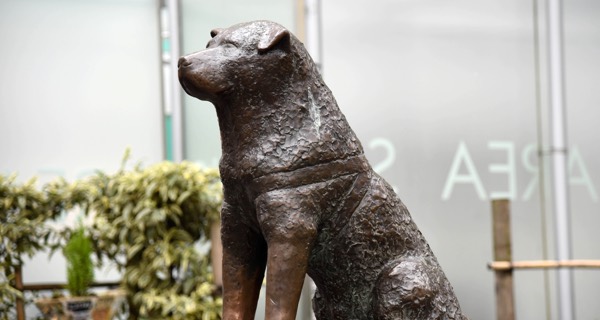
the U.S. Outside of a Tokyo train station
there is a statue of Hachiko, faithful
pet of Dr. Elisaburo Ueno. The dog waited faithfully
each day for his master
to debark the train after work. One day
the master did not come home, but still Hachiko waited,
keeping up his
daily vigil for nine years. He was fed
by station attendants until his death, and each year
a solemn ceremony is held
in his honor. Keller was so taken with
the story of the dog's fidelity that the Ministry of
Education presented
her with an Akita puppy named Kamikaze.
Later, when the puppy died, the Ministry sent a second
Akita to Miss
Keller.
The
breed's popularity in the U.S. really started when returning
servicemen brought
the dogs home with
them. They
were attracted to the dogs' strength
and adaptability. The Akita Club was founded in 1956,
and the breed was
admitted to registration in the American
Kennel Club Stud Book in
October, 1972, and to regular show
classification in 1973.
It
is not uncommon for the uninitiated to ask
if
the Akita
is a cross between a dog and a bear.
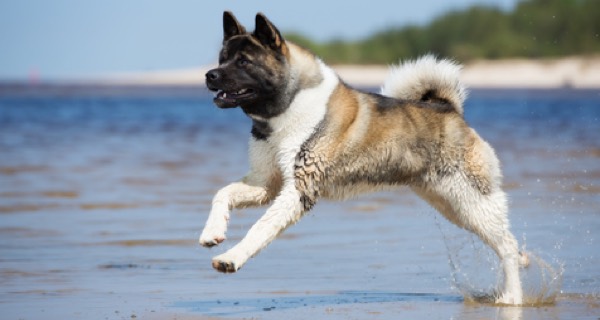
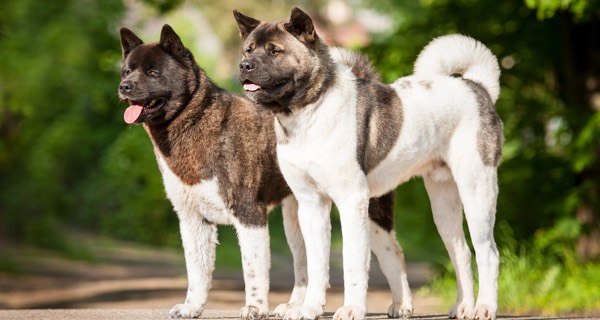
Indeed, its massive head and chest do "bear" a certain resemblance
to the larger mammals. One distinctive feature of the
Akita is its fine ears: erect, triangular, small ears,
set slanting
forward and on either side of the head. Another Akita
feature you can't miss is its tail, set high and carried
in a curve
over its back. Its eyes are deep-set and triangular.
The
Akita is a liberal combination of kindness, courage and
alertness. It is extraordinarily affectionate and
tolerant. It is also very protective
and will defend itself and its
charges against others, particularly
other dogs. It is intelligent and retains its lessons
very well. It can't
be bullied into submissiveness
and will resent forceful training methods and nagging.
Akitas
will not tolerate physical abuse. They are strong
willed dogs with proud egos. They need firm handling,
patience
and praise. Large breeds like
the Akita have a potential for violence and should not
be
sold to weak-willed or
impatient owners. These dogs
won't stand for mistreatment and will
resent disciplinary training
tactics sometimes used on other large breeds. An Akita
may live
10 to 12 years
and needs love and gentle guidance
to prosper. Because of their
strength, Akitas in the wrong
environment, or without proper training, can be dangerous.
Akita
puppies resemble
teddy bears as much as older
dogs resemble the full-sized, real ones.
The Akita litter is usually about 8 to 10 pups. Pet
quality pups cost
about
$500 to $700, while show quality
ones will cost $1,500 of more.
At
3 months, an Akita pup might weigh more than
30 pounds, and at 10 months,
it is filled out to nearly adult stature.
Akitas will adjust to any
climate and don't require as much exercise as other large
breeds; however, a large,
fenced yard should be considered
a necessity.
Akitas
mature at 3 to 4 years
of age and should be given calcium supplements while
growing, if a need is indicated.
Akitas
are basically sound with
few health problems. Conscientious breeders have their
stock x-rayed for hip dysplasia.
Bloat
is a life threatening
condition to watch for that requires immediate veterinary
attention.
It can be prevented by
making sure meals are
digested before vigorous exercise and that water is not
drunk
in excess. Otherwise, regular
grooming, veterinary
checkups and a good diet will keep the Akita in good
condition.
An
Akita is an intrepid guardian of its family
and property. In Japan, it is often left to baby-sit
children while mothers
go off to work. It
will not bark unless thoroughly alarmed, so it can be
kept
in close proximity to neighbors. It
is an ideal car passenger
that won't fuss, drool, or get sick,
and it keeps itself
fastidiously clean. Akitas shed twice a year, unless
kept in a cold
climate in which case they
shed only once.
They
are known for their mild disposition and their ability
to "keep their cool" in stressful situations.
One bad habit they seem to have is "goosing" people,
and being gored from either front or behind by one
of these dogs can be embarrassing. The Akita is also
inclined
to
be jealous, so showing affection to other family pets
will have to be handled diplomatically.
Akitas
are gentle, extremely loyal dogs. They won the
heart of their
native land with their kind disposition and loving nature,
and for a few special owners, they
are the only breed
to own. In Japan, they are considered good
luck and are often
given to ill persons or families with newborns to bring
good fortune and happiness into
their
homes. But no matter
what country and customs it must adhere to, the Akita
is a versatile and revered companion,
capable
of loving and protecting
its family for many years.